A.V. Shchusev Museum of Architecture, Moscow · 14 March – 13 June 2025
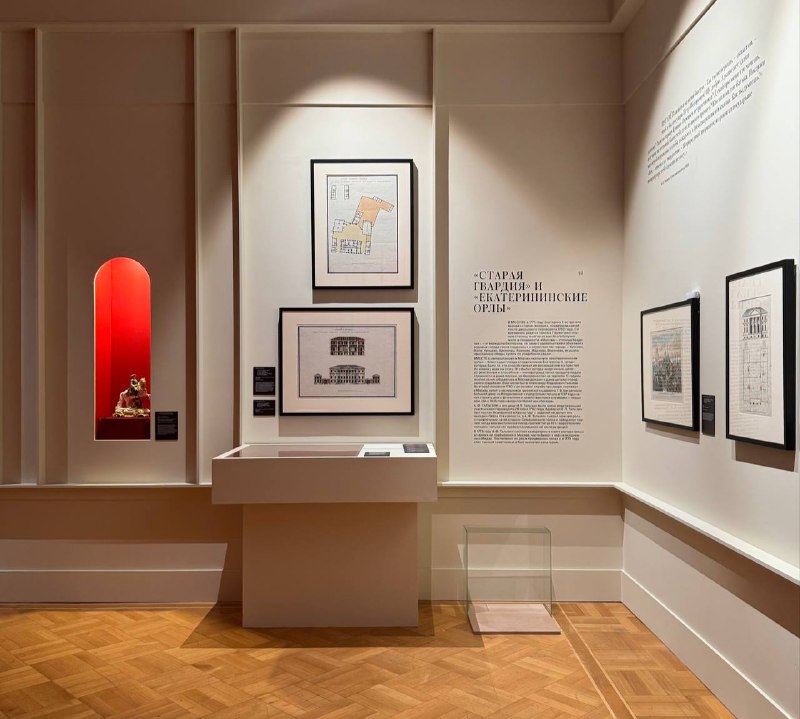
When we speak of the 18th century, Petersburg is what first comes to mind. It was Petersburg that became the main stage of the Russian Empire, and it was there that Catherine II built palaces and a new cultural environment took shape. But in 1775 an important episode unfolded in Moscow – the empress arrived here after the signing of the Treaty of Küçük Kaynarca, which secured the expansion of the state's borders. The A.V. Shchusev Museum of Architecture has presented an exhibition devoted to Catherine's Moscow triumph. The exhibition is not about palaces and ceremonies in the usual sense, but about what the capital looked like during this visit, what symbols of power she left behind and how this is connected with changes in the urban environment.
The exhibition consists of several sections. At its center are original drawings of Moscow palaces and plans of the temporary buildings created specially for the empress's arrival. Among the most interesting exhibits:
• Design for the wooden palace on Volkhonka
— Catherine's temporary residence, built for her arrival but soon dismantled. The exhibition shows the drawings of this building for the first time.
• Engravings and maps of Moscow from the 1770s
— They make it possible to see what the city was like in Catherine's era: where the ceremonial entrances were located, what the main squares looked like.
• Personal belongings and decorative elements
— Here are both fragments of palace décor and objects from the everyday life of the nobility.
• Iconostasis of the house church of the Prechistensky Palace
— One of the key symbols of power of the time, presented in the exhibition space.
Moscow in the second half of the 18th century was a city in which the past and the future did not always coincide. The empress was actively rebuilding Petersburg, while here many palaces remained neglected. Catherine's visit became a kind of impetus for development – it was at this time that the modernization of the old imperial residences and the renewal of the city's infrastructure began.
The enfilade of the Talyzin-Ustinov estate, where the exhibition is housed, turns into a historical scenario: diary entries, quotations from Catherine II, a diagram of the route of her triumphal entry. Everything is arranged so that visitors do not simply look at documents and artifacts but understand how they worked in the real urban space.
This is not only an exhibition about Catherine the Great. It is an exhibition about Moscow, which at that moment was not the capital but remained a key symbol of the empire. The exhibition shows how power used the urban environment to create an imperial image, and how architecture became an instrument of this policy.
In the post:
• Image of the illumination and fireworks presented before the newly built winter house of Her Imperial Majesty for the New Year 1754 in Moscow
• Iconostasis of the house church of the Prechistensky Palace