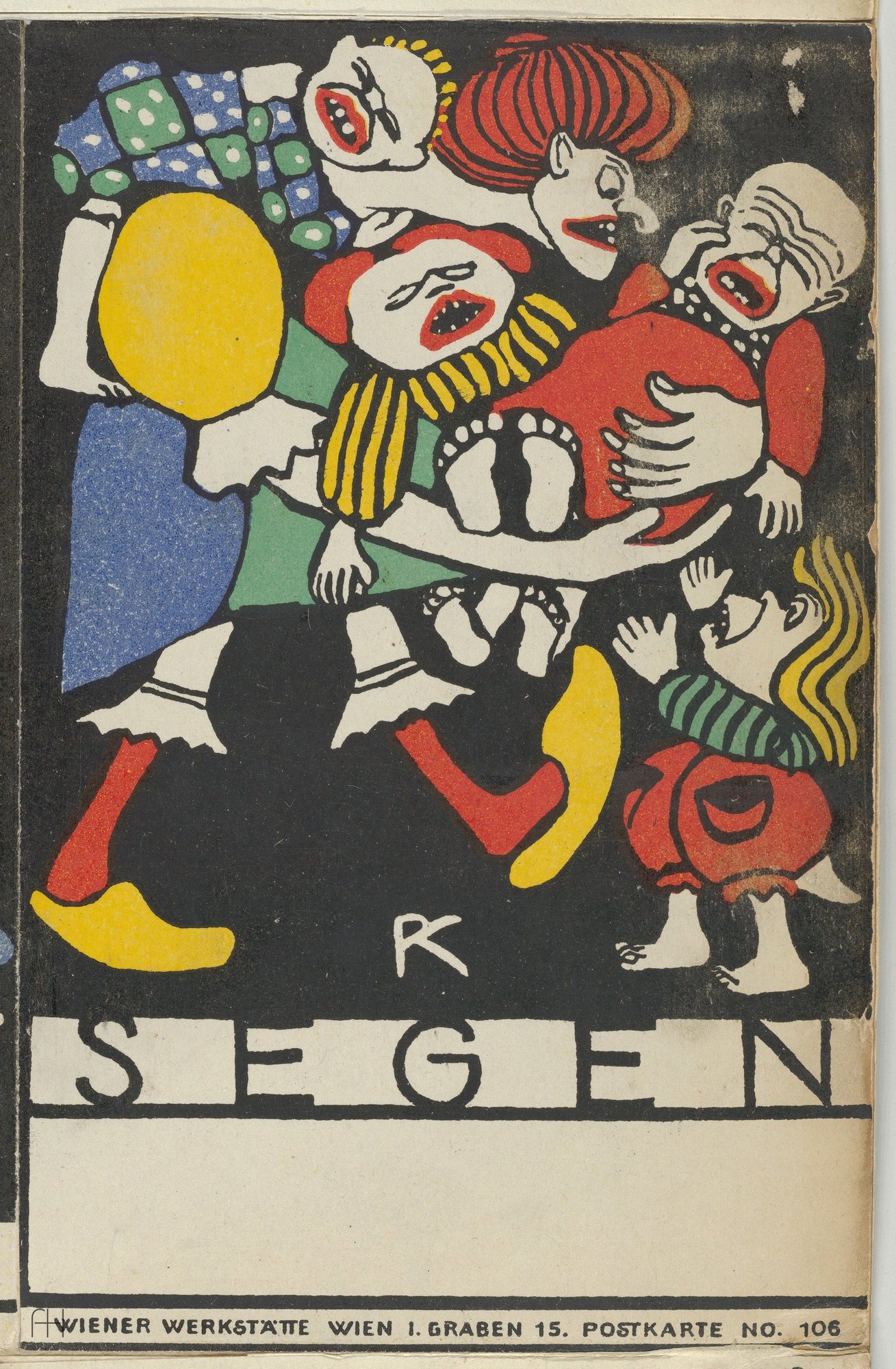
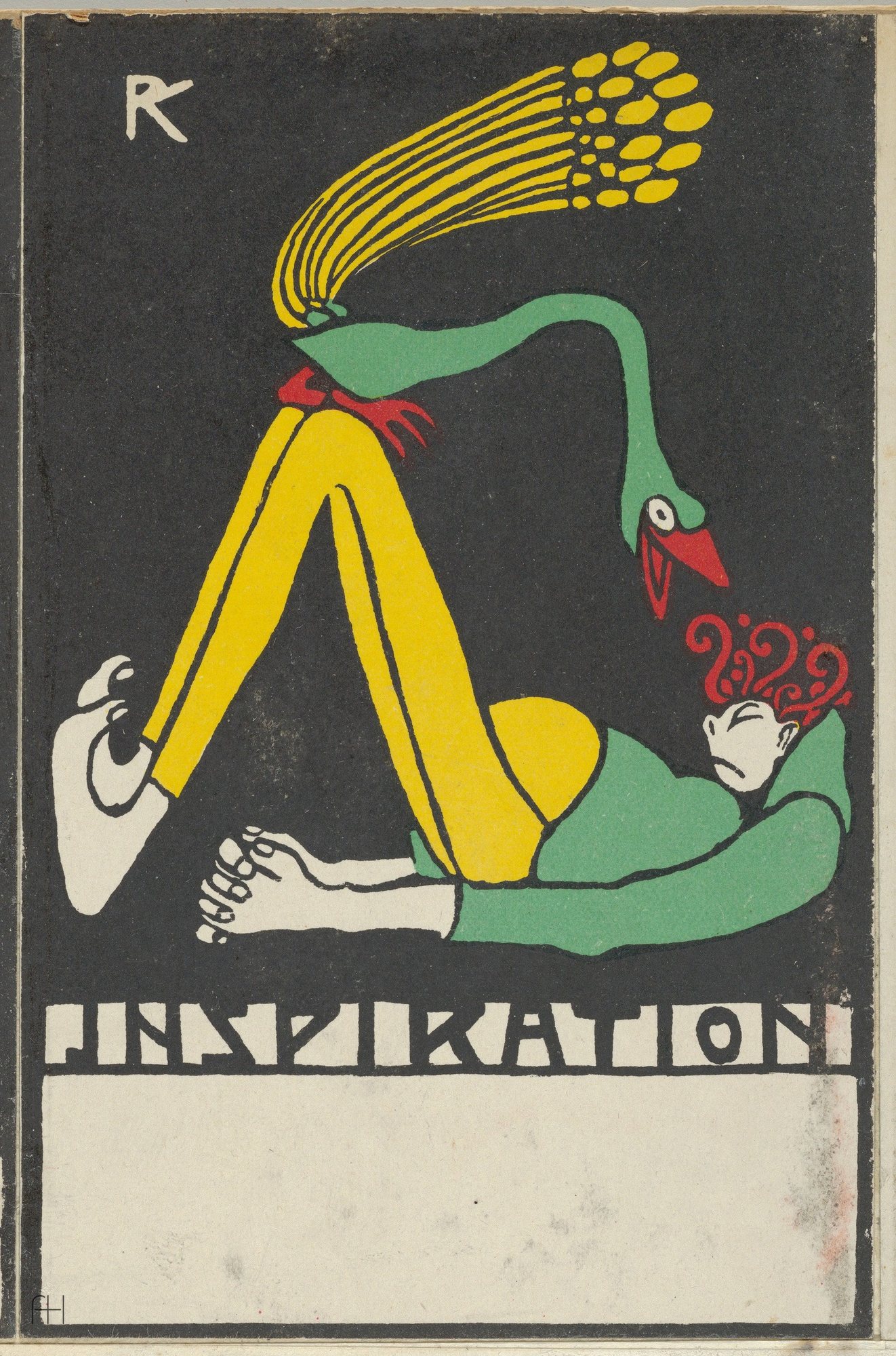
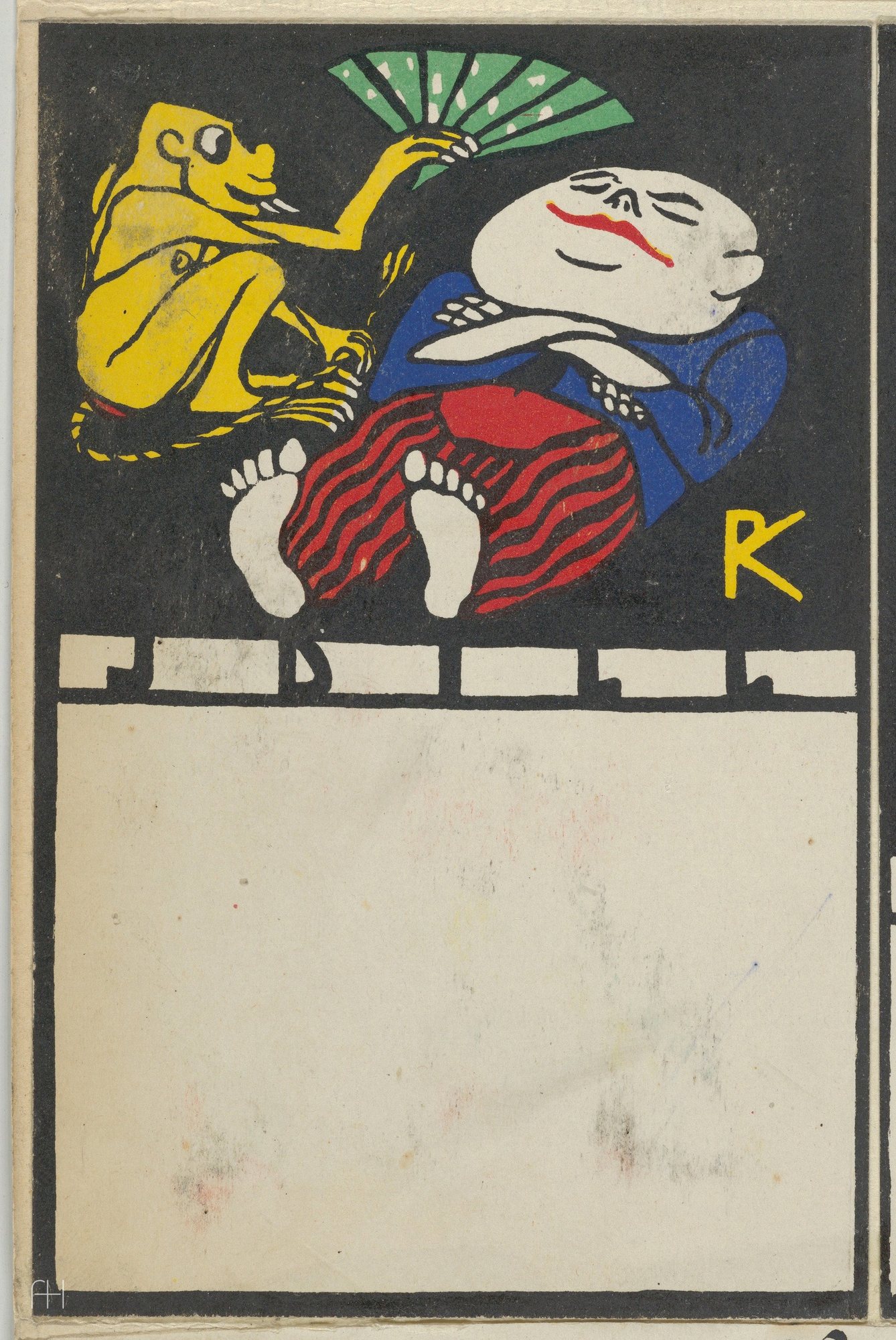
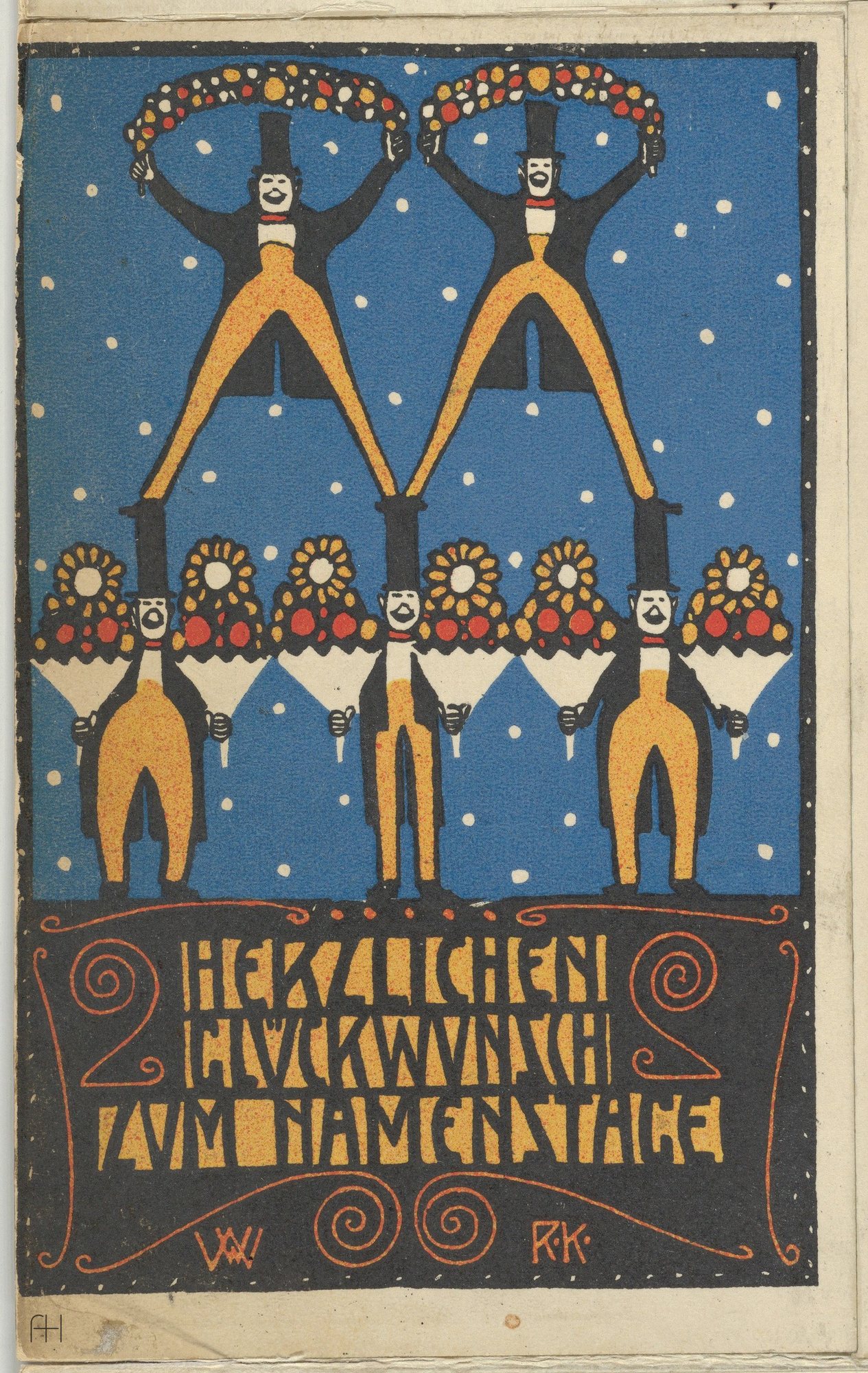
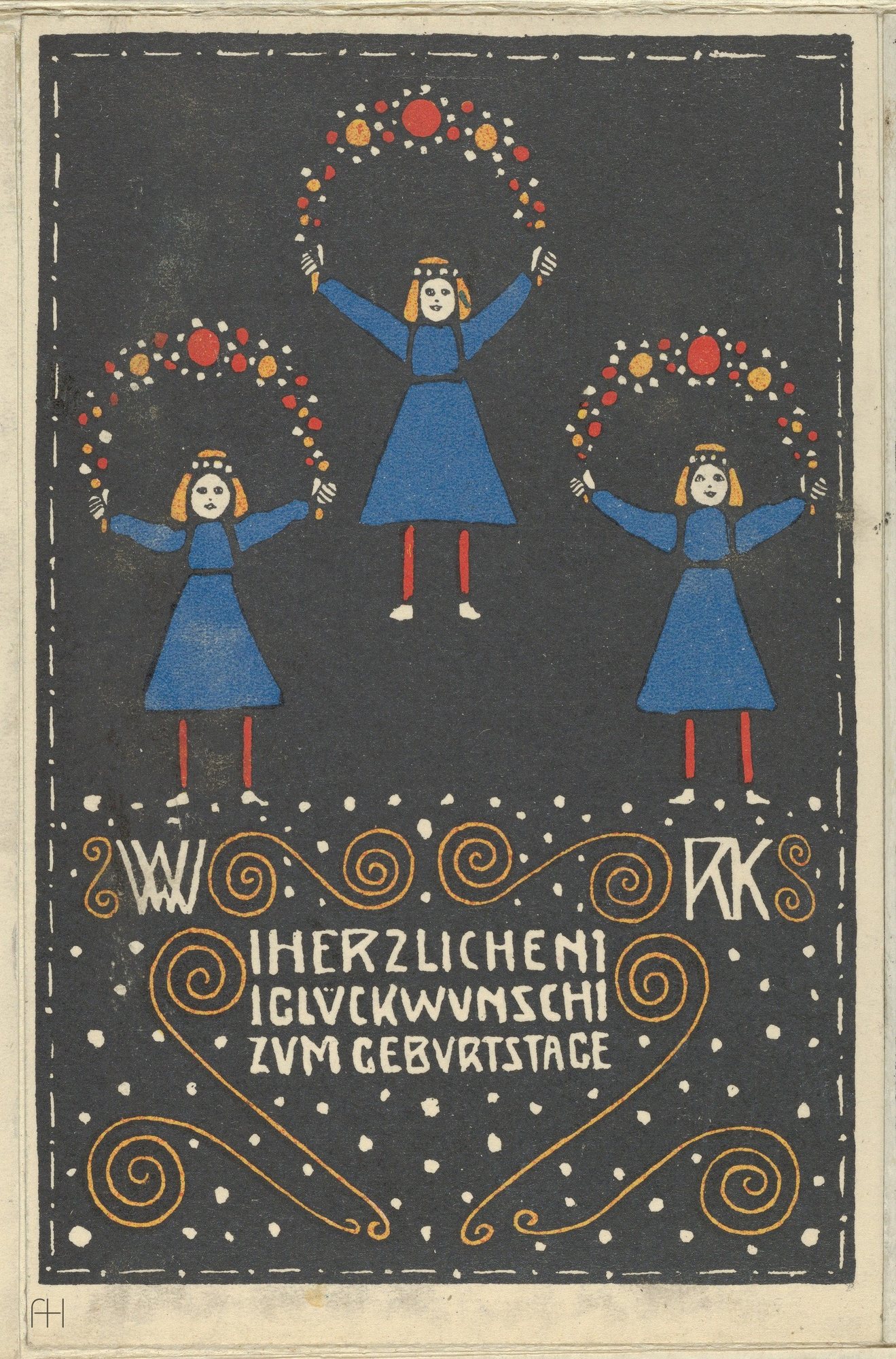
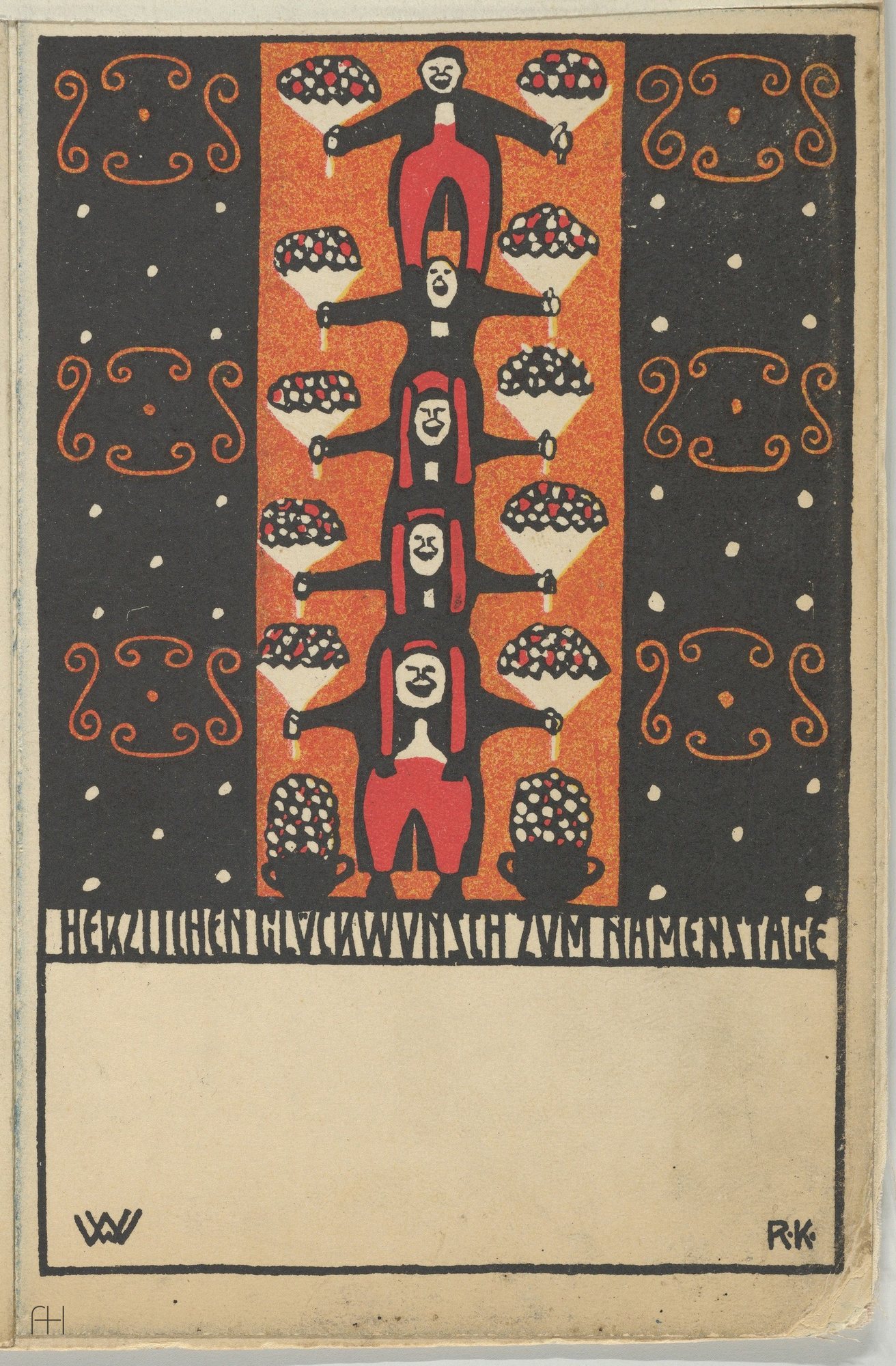
Rudolf Kalvach studied at the School of Applied Arts in Vienna together with Kokoschka, and in those years it was Kokoschka who learned from him. By all appearances he redrew Kalvach's drawings while looking for his own manner. For the Wiener Werkstätte Kalvach managed to make 21 postcards, and almost all of them make fun of greetings: inspiration torments a young man like a bad dream, and "Blessing" bends a mother under a pile of screaming children.
In May 1912 he was committed to a psychiatric hospital with a diagnosis of "schizophrenia". After that came Steinhof in Vienna and Kosmonosy in Bohemia, where he died of tuberculosis in 1932. The Wiener Werkstätte closed that same year.
Kalvach's father drove locomotives on the Vienna–Trieste line. His teacher Bertold Löffler remembered that twice a week the son rode along as an assistant and came to school straight from the Südbahn, black with coal soot, and sat down to his "strange things". In 1906, after the "Die Jungen" exhibition at Galerie Miethke, he sold three paintings and six woodcuts. The Leopold Museum considers them some of the first Expressionist works in Vienna.
The postcards were sold in the Werkstätte's salon on the Graben, and almost nobody planned to write on them. The collector Leonard Lauder said that about 95% of the Wiener Werkstätte postcards he had seen were left blank. Kalvach had only one print run, and not a single surviving copy of his "Motherly Happiness" was ever sent through the mail.
At the same time he drew posters for the Austrian Lloyd, and in 1910 The Studio printed reproductions of them. His large oil paintings have almost all been lost. "The Hunt", a canvas of roughly one and a half by two meters, is listed as lost.