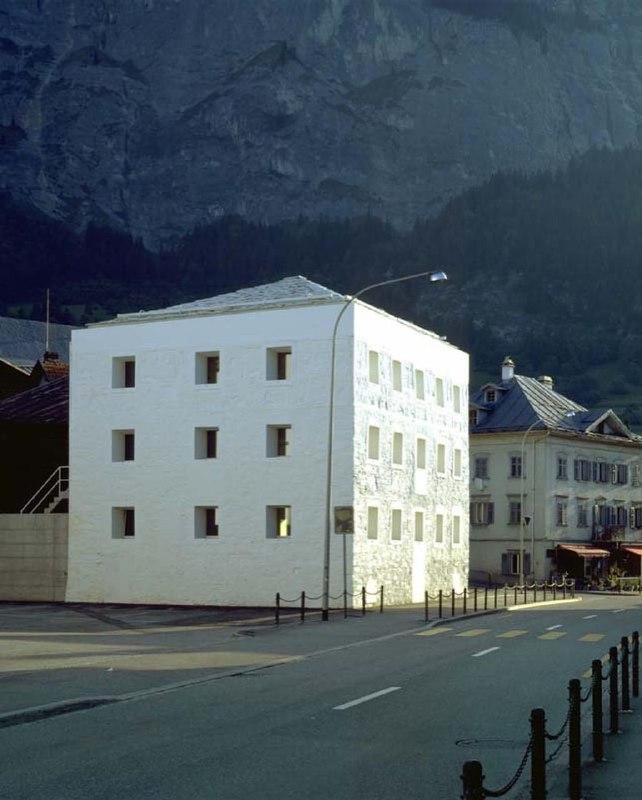
For twenty years this house remained abandoned, and it received the name Das Gelbe Haus (German for Yellow House) after it was repainted yellow before its reconstruction. It was originally a residential building belonging to the parish of Flims. Under an agreement with the architect Rudolf Olgiati, it was to be restored in accordance with his architectural principles: a white facade and a stone roof.
After Olgiati's death, the parish decided to convert the building into an exhibition space. However, the complex internal structure of the house did not suit the new function, which called for a radical intervention. The interiors were completely dismantled and rebuilt in solid wood, the old plaster was removed to expose the stone walls, and the roof was replaced with randomly selected stone slabs. Unnecessary openings were filled in, and the new ones were given concrete frames cast on site. Finally, the entire building—the interior timber structures, the stone walls and the new roof—was coated with white lime paint.
This last layer conceals all imperfections but at the same time creates a paradox. The whiteness turns the archaic, almost animal materiality of the house into an abstraction, giving it a vision—a materialized architectural thought.